Autonomous AI Agents: The Next Step Beyond RPA Automation
The Glass Ceiling of Traditional RPA
RPA was a necessary revolution. It allowed “bots” to mimic human actions on a screen: copy, paste, fill out forms, and move data. However, RPA is rigid. It operates under the premise “if A happens, do B.”
What is the real pain point in the office? That the moment an invoice changes format, a customer asks an off-script question, or data in SAP shows an unexpected anomaly, the RPA bot stops. This creates a critical reliance on human oversight to resolve exceptions, turning what should be a seamless process into a constant cycle of manual corrections and patches in Excel files.
The Cost of Rigidity in a Dynamic World
Continuing to rely exclusively on linear automation is, today, a drain on profitability. According to the Gartner Top Strategic Technology Trends 2025-2026 report, the evolution toward “agent-based” systems is inevitable: it is estimated that by 2028, at least 33% of enterprise software applications will include autonomous AI agents, up from less than 1% in 2024.
If your company fails to evolve, top talent—your managers and consultants—will continue to waste valuable hours validating what the technology “couldn’t understand.” According to IBM data, companies that fail to integrate intelligence into their processes see their technology ROI stagnate, as the maintenance costs of rigid bots often equal or exceed the long-term savings they generate.
AI Agents Built on the Robustness of Microsoft Azure
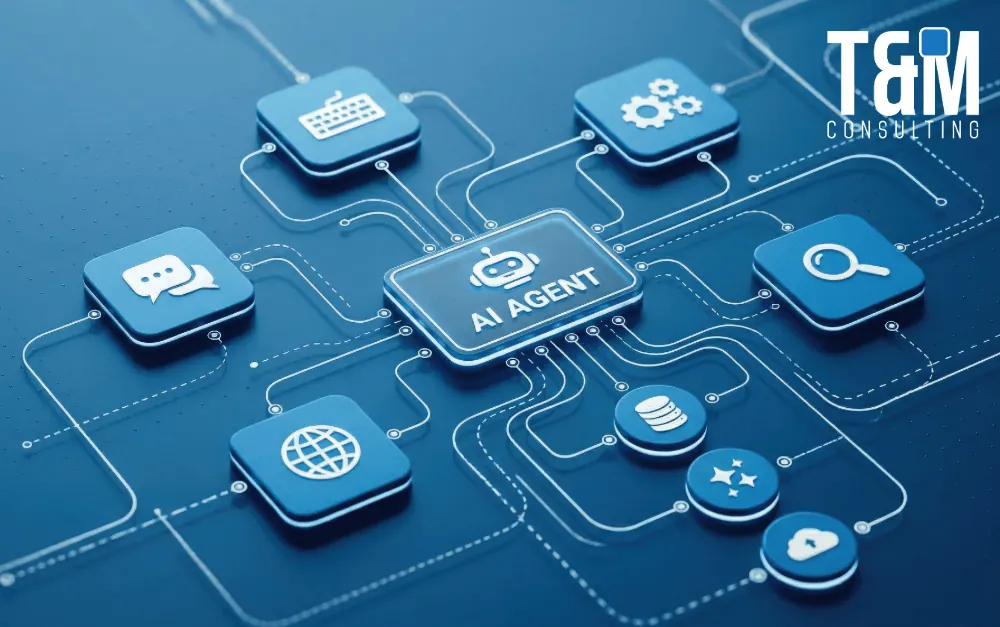
The difference between a bot and an Autonomous AI Agent is the ability to reason. While a bot follows instructions, an agent pursues objectives.
At T&M Consulting, we help organizations make the leap from tactical automation to strategic autonomy using the Microsoft Azure ecosystem. Our competitive advantage is clear: we have Microsoft-certified consultants who are experts in integrating Azure OpenAI Service and Azure AI Studio with your existing systems.
What do we achieve with Autonomous AI Agents?
1. Real-time decision-making: Agents can analyze an exception in an SAP procurement process and determine the best course of action based on historical data and current context.
2. Natural Language Understanding: They interact with customers and suppliers seamlessly, extracting intent and context, not just keywords.
3. Deep Integration: By operating on Azure, these agents connect natively and securely with your web applications, databases, and cloud architecture, ensuring that information never leaves the corporate security perimeter.
This isn’t about replacing RPA, but rather equipping it with a “brain” capable of handling ambiguity. At our offices in Monterrey, the Dominican Republic, and Venezuela, we’ve seen how this transition reduces operational cycle times by up to 40%, freeing up staff for truly innovative tasks.
Is your infrastructure ready to stop executing and start reasoning?
The future of B2B operations in Latin America is neither manual nor rigidly automated; it is autonomous. At T&M Consulting, we combine our expertise in SAP and Azure to deliver the digital workforce of tomorrow.
Don’t let your company get stuck in the automation of the past. Discover how our AI agents can transform your critical processes.
Schedule a personalized demo with our Microsoft-certified experts