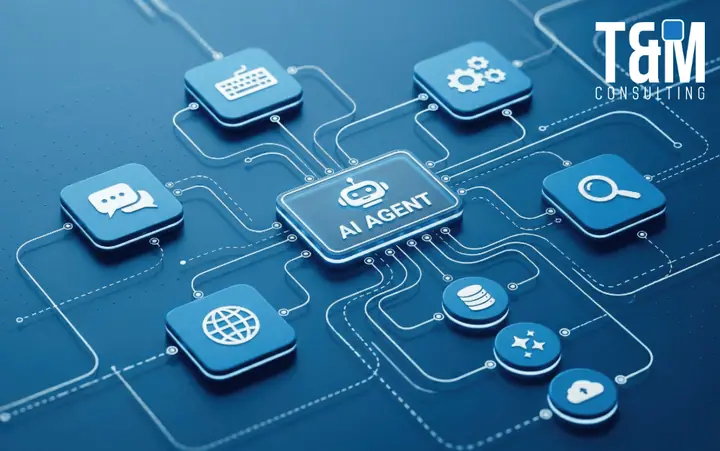

How to leverage AI and Machine Learning for new opportunities in software development in 2025

In 2025, learning and applying these technologies will not only be a competitive advantage, but a necessity for developers who want to open up new opportunities in their careers. AI and ML-driven solutions are transforming the way applications are developed, processes are automated, and data-driven decisions are made.
In this article, we'll explore how learning and applying AI/ML can transform your career as a software developer, and give you some key steps and resources to get started.
Why artificial intelligence and machine learning will be critical in 2025
As companies look for more efficient ways to manage large volumes of data and improve their business processes, AI and ML technologies are at the heart of these transformations. Applications ranging from personalized recommendations to machine vision systems have driven demand for professionals with AI and ML skills. AI platforms are no longer just experimental tools but have become essential components for companies across all industries.
In this context, developing AI/ML skills is an excellent way to stand out in the job market and expand your job prospects.
The Impact of AI and ML on Software Development
1. Development automation with AI and ML
One of the biggest impacts of artificial intelligence on software development is the ability to automate processes that previously required manual intervention. Developers today have tools that optimize everything from code creation to application testing and deployment. For example, tools like GitHub Copilot use AI to help programmers write code faster and with fewer errors.
Practical example: ML algorithms can analyze thousands of lines of code and suggest improvements or detect potential bugs, which saves time and improves the quality of the final product.
2. Personalization in web and mobile applications
AI has enabled developers to create personalized experiences for users. Platforms such as Netflix and Spotify use ML to provide recommendations based on user behavior, increasing customer satisfaction and improving retention.
How to apply: By learning how to integrate ML into your apps, you can develop personalized recommendation systems that tailor content or products to individual user preferences.
3. Predictive analytics and decision making
ML-based predictive models allow companies to anticipate future behavior based on historical data. This approach is key for areas such as finance, marketing and supply chain management, where accuracy in decision making is critical.
How to apply it: You can implement predictive analytics models in management systems to forecast demands, risks or trends in data, thus improving business efficiency.
Steps to learn AI and ML this 2025
1. Master the fundamentals
Before diving into advanced ML algorithms, it's important to understand the fundamentals of the mathematics and statistics that drive AI. Concepts like linear regression, linear algebra, and differential calculus form the basis of many machine learning algorithms.
Recommended resources:
Coursera: Machine Learning by Andrew Ng. One of the most popular courses for gaining a solid understanding of ML.
edX: AI for Everyone for an introduction to AI from a business perspective.
2. Learn Python and AI frameworks
Python has become the language of choice for AI and ML thanks to its simplicity and the large number of libraries available such as TensorFlow, Keras and scikit-learn. Learning how to use these tools will allow you to implement ML models in your applications.
Key steps:
Familiarize yourself with Python libraries for ML such as Pandas and NumPy.
Explore TensorFlow and PyTorch for creating neural network models.
3. Work on hands-on projects
Learning AI and ML is not complete without practice. Developing projects based on real data is the best way to understand how the models work and how they can be applied in real-world situations.
Project ideas:
Image recognition: use an image dataset to train a model that classifies objects.
Recommendation system: Create a product or content recommendation system using user behavior data.
4. Participate in AI and ML competitions
A great way to accelerate your learning is to join competitions like Kaggle, where you can test your skills by solving real problems with challenging datasets.
Benefits:
Gain hands-on experience working with large volumes of data.
Receive feedback from the community to improve your models and techniques.
5. Keep up to date with the latest trends
AI and ML are evolving rapidly. In 2024, technologies such as deep learning and large language models (LLMs) like ChatGPT will set new directions in software development. Stay on top of what's new by attending conferences, reading specialized articles, and participating in webinars.
Recommended sources:
Google AI Blog: Frequent updates on AI research and applications.
OpenAI: Information on the latest innovations in AI and deep learning.
Career opportunities in AI and ML
Knowledge in AI and ML not only makes you a better developer, but also opens up a range of new career opportunities. Companies are looking for experts in predictive modeling, natural language processing (NLP), and data analytics to optimize processes, improve customer experience, and generate valuable insights from large volumes of data.
Career Highlights:
Machine Learning Engineer: Specializing in the development and maintenance of ML models.
Data Scientist: In charge of analyzing and interpreting large amounts of data using AI algorithms.
AI Developer: Designs applications that integrate AI into software products.
Learning and the application of artificial intelligence and machine learning are not just passing trends; they are fundamental skills for any developer who wants to be on the cutting edge in 2024. These technologies are redefining the way companies create products, optimize processes and make decisions. If you want to open up new opportunities in software development, now is the perfect time to start your journey in AI and ML.
With the right resources and a hands-on approach, you can develop the skills you need to be part of this technological revolution and transform your career.
Sources:
Coursera: Machine Learning by Andrew Ng.
OpenAI: Recent innovations in AI.
Google AI Blog: Research and News.
Remember to follow us on our networks to learn more about the world of technology and trending topics.