Beyond ChatGPT: How AI Agents Are Redefining SAP Basis Support and Cloud Monitoring
The arrival of conversational models (such as ChatGPT) was only the first act, the “hype.” The second act, that of real and critical utility, stars AI agents.
Unlike a talking chatbot, an AI agent acts. These are systems capable of perceiving, reasoning, deciding, and executing corrective actions in complex environments such as SAP S/4HANA and multi-cloud architectures, without direct human intervention.
For CIOs in Mexico, Colombia, or the Caribbean, where the cost of specialized SAP Basis talent is skyrocketing and cybersecurity risks are growing exponentially, understanding this distinction is not a technical issue, it is a matter of financial survival.
This article explores why critical and predictive automation is the only way to reduce operational risk and eliminate the hidden costs of downtime.
The Silent Pain: The Complexity of Hybrid Environments in 2025
Before discussing the solution, let's diagnose the problem. IT infrastructure management has reached an unsustainable tipping point for traditional human teams.
For SAP Basis and Cloud Operations teams, the reality is overwhelming:
Hybrid Landscapes: Data that lives between legacy on-premise servers and new instances in Azure, AWS, or Google Cloud.
The Pressure of S/4HANA: Complex migrations that require granular monitoring of the in-memory database (HANA), where a spike in memory consumption can halt the entire company's billing.
Third-Party Dependencies: An ecosystem of APIs and microservices where an external failure can trigger an internal domino effect.
The traditional “reactive monitoring” model (waiting for a red light to come on on the dashboard to call an engineer) is broken. According to Gartner data, the average cost of IT downtime is $5,600 per minute. In a critical manufacturing or banking operation in Latin America, one hour of downtime can cost more than $300,000, not counting reputational damage.
The operational risk is no longer whether the system will fail, but how long it will take humans to notice and fix it. This is where Critical Automation comes in.
From Chatbot to Synthetic Engineer: The Anatomy of an AI Agent
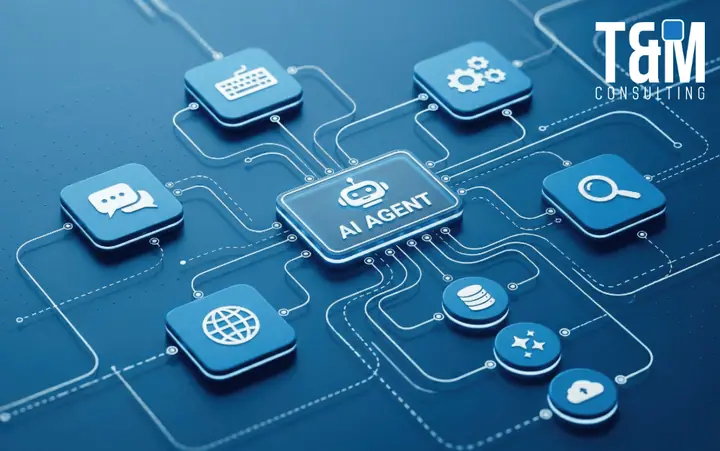
To understand how we are redefining support, we must demystify the technology. An AI Agent is not just a language model (LLM); it is an orchestrator system.
While ChatGPT is a “Text Input -> Text Output” system, an AI Agent for IT Operations (AIOps) operates under a continuous cycle of Observation, Diagnosis, and Execution:
Observation (Data Ingestion): The agent is connected to SAP logs, cloud performance metrics, and real-time security alerts. It does not “read” monthly reports; it “feels” the pulse of the system millisecond by millisecond.
Reasoning and Diagnosis (The Brain): Using predictive models, the agent does not just see that CPU usage rose to 90%. It understands the context: "Is it month-end? Was a patch applied yesterday? Is it a DDoS attack?" It diagnoses the root cause based on gigabytes of historical data that would take a human weeks to analyze.
Execution (The Hands): This is where the revolution lies. The agent has permission to execute playbooks or remediation scripts. It can restart a service, block a suspicious IP, or free up disk space autonomously.
SAP estimates that well-trained AI agents can handle up to 80% of transactional and repetitive tasks in SAP system administration. This is not just efficiency; it is the reallocation of human talent toward strategy.
Critical Use Cases: Where AI Saves ROI
The theory sounds good, but how does this look in the operational trenches of a company in Latin America?
1. Predictive Monitoring and Self-Healing in SAP HANA
The biggest fear of a Basis administrator is the collapse of the HANA database due to memory saturation.
The old approach: An alert sounds at 3:00 AM. The engineer wakes up, connects to the VPN (15 min), reviews the logs (20 min), identifies a malicious or inefficient SQL query, and kills it (5 min). Total downtime or degradation: 40 minutes.
The agent-based approach: The agent detects an abnormal trend in memory consumption two hours before the crash (prediction). It analyzes the process threads, identifies the problematic SQL query, and applies a resource restriction or alerts the developer with the exact solution, all without degrading the service.
Result: Zero downtime. No human intervention in the emergency.
2. Patch Automation and Regression Testing
Applying security patches in critical environments is often a logistical nightmare that gets postponed for fear of “breaking something.”
The Agent in Action: The agent identifies a critical vulnerability. It automatically creates a cloned “sandbox” environment (ephemeral digital twin), applies the patch, runs a battery of 500 regression tests, and if everything is successful, schedules the deployment in production or requests final approval from the human with a “Zero Risk” report.
Result: Immediate regulatory compliance and reduced risk of bugs in production.
3. Cybersecurity: Access Management and SoD (Segregation of Duties)
In LATAM, internal fraud is a major concern.
The Agent in Action: Using behavioral analysis, the agent detects that a user with a “Purchasing” role has suddenly acquired “Payments” privileges due to a misconfiguration or a forgotten temporary change. The agent immediately revokes access and notifies audit.
Result: Real-time fraud prevention and clean audits.
The Cost of Inaction: Why “Wait and See” is a Losing Strategy
Skepticism is natural, but market data indicates that we are in a race against time.
IBM's Cost of a Data Breach Report 2024 reveals that the average cost of a data breach reached $4.88 million. Even more alarming is the fact that incidents involving data distributed across multiple (hybrid) environments are the most expensive and take the longest to contain (more than 280 days on average).
In our region, where cloud security is the number one concern for CIOs, the gap between security investment and attack sophistication is widening.
Not adopting automation agents means:
- Slow detections: Relying on human eyes to monitor millions of lines of logs.
- Unmet RTO/RPO: When disaster strikes, manual recovery is slow and prone to stress-induced errors.
- Talent Drain: Your best Basis engineers will burn out performing repetitive tasks instead of innovating, and they will leave for the competition.
The adoption of agents in production already exceeds 50% in global companies leading the digital transformation. Staying out of this wave is not a cost saving; it is the accumulation of unpayable technical debt.
T&M Consulting: Governance and Traceability in the Age of AI
We know what you're thinking: “Giving the keys to my SAP to an AI sounds risky.” And you're right. Uncontrolled automation is accelerated chaos.
This is where T&M Consulting differs from generic integrators. We don't sell “magic”; we implement Governed Automation Architectures.
Our approach to the Mexican and Caribbean market is based on three pillars:
- Zero Trust Design: No agent, human or synthetic, is implicitly trusted. Every action by the agent is verified, limited by minimal privileges, and recorded in an immutable log.
- Human-in-the-loop (Strategic Human Oversight): We configure agents to handle autonomy in levels. For low-risk decisions (deleting temporary logs), the agent acts alone. For critical decisions (restoring a backup), the agent prepares everything and waits for confirmation from a senior T&M expert.
- LATAM Regulatory Compliance: Our agents are designed with local data protection and information sovereignty regulations in mind, ensuring that automation does not compromise compliance.
The Future is Autonomous
The question for the CIO of 2026 is not whether to use AI in their operations, but how quickly they can delegate the operational to reclaim the strategic.
AI agents are not here to replace your IT team; they are here to free them from the tyranny of “maintenance” so they can focus on “transformation.” They are here to ensure that your migration to the cloud or SAP S/4HANA is robust, resilient, and cost-effective.
At T&M Consulting, we are ready to help you build that future today. Migrating is necessary; migrating with artificial intelligence is the ultimate competitive advantage.
Key Data for the CIO
80% reduction in routine manual SAP Basis tasks (Source: SAP Estimates).
$5,600 USD is the average cost per minute of IT downtime (Source: Gartner).
< 1 minute: Reaction time of an AI agent vs. 60+ minutes for an average human when responding to nighttime incidents.
Is your operation ready for the era of “Artificial Agency”? Schedule an AI Operational Maturity Assessment