
IT Outsourcing with AI Agents: From Fixed Cost to Smart ROI
The Great Challenge of the Latin American CIO: The Constant Increase in OPEX and the Trap of Human Dependency
Historically, IT costs have been seen as an inevitable and growing fixed cost. Dependence on the human factor is a double-edged sword: on the one hand, it is the source of innovation; on the other, it is the cause of variability in quality, a shortage of specialized talent (especially in areas such as cybersecurity and advanced cloud computing), and, most critically for the board of directors, the constant increase in salary and operating costs.
The pain is palpable:
Increased OPEX: Salaries, training, licenses, and physical infrastructure continue to climb.
Human Dependency: Staff turnover (an acute problem in the region) and the need to hire expensive engineers for routine and repetitive tasks.
Lack of Strategic Focus: High-level human talent is consumed by putting out fires (the famous “firefighting work”) instead of dedicating themselves to projects that generate a real competitive advantage for the business.
The traditional solution to this dilemma has been outsourcing or, more recently, the Managed Service Provider (MSP) model. But what if we told you that this model is no longer sufficient? The time has come to talk about evolution: Outsourcing 2.0 with Artificial Intelligence (AI) and T&M Agents.
Outsourcing 2.0: Economic Efficiency and the Promise of a Demonstrable ROI
The traditional MSP model promised cost predictability and access to expertise. However, it often becomes a disguised fixed cost, where the actual efficiency of the provider is limited by the very human dependency you are trying to mitigate.
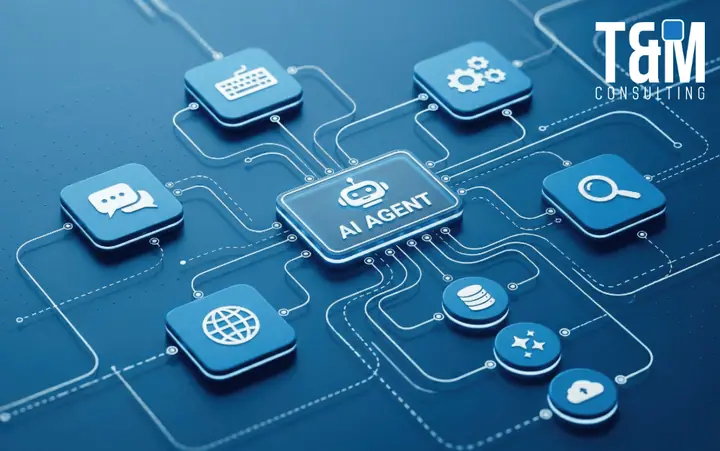
Outsourcing 2.0 is the total disruption of this equation. It is based on a bold and economically attractive premise: using AI and Machine Learning (ML) agents to automate the vast majority of IT tasks that are repetitive, predictive, and rule-based.
The 80/20 Model of AI in IT
Our proposal is based on surgical optimization of work:
80% Predictive and Repetitive Tasks → AI Agents:
Log and alert monitoring.
Patch and software update management.
Level 1 incident resolution (password resets, basic connectivity issues).
Basic cybersecurity and routine vulnerability analysis.
Generation of compliance and operation reports.
20% Strategic and High-Value Tasks → The Human Expert:
Cloud architecture design and migration of critical workloads.
Response to complex security incidents (advanced persistent threats).
Digital roadmap planning and IT budgeting.
Innovation and development of new internal solutions (e.g., business applications).
This distribution is the key to economic efficiency. You stop paying premium engineer rates for tasks that a machine can perform faster, more accurately, and, crucially, 24/7 without fatigue or human error.
Statistical Support: AI is not the Future, it is the Present of Savings
The global IT market is already validating this transition, and Latin America is no exception.
1. The Need for Cost Reduction in the Region
According to a Gartner report on IT trends in Latin America, cost optimization and operational efficiency are consistently cited as the top priorities for regional CIOs. It is estimated that companies that implement intelligent automation in their IT operations can see an OPEX reduction of up to 30% in the first year in support and infrastructure management tasks alone.
2. Savings in Resolution Rate and Quality (T&M vs. AI)
The most impactful metric is resolution speed. A human agent can take minutes or hours to diagnose a Level 1 network problem. An AI agent, equipped with real-time log analysis capabilities, can diagnose and often proactively resolve issues in seconds.
Key Statistic: A Harvard Business Review study found that implementing AI in IT service management (ITSM) can increase first contact resolution (FCR) rates by more than 40% and reduce mean time to resolution (MTTR) by up to 60% for routine incidents. This translates directly into less business disruption and immediate ROI.
3. Talent Shortage and the Cost of Know-How
The cost of a certified cloud engineer (AWS, Azure, GCP) or cybersecurity specialist in the region has skyrocketed. Reliance on a few key individuals is a continuity risk. By outsourcing 80% of tasks to AI, you:
Reduce the operational risk associated with staff turnover.
Convert a fixed and growing salary into a variable and scalable cost, aligned with actual service usage.
Ensure 24/7 availability of expertise, without paying overtime or night shifts at human engineering rates.
From Spending to Investing: Transforming Your IT Budget
The most powerful concept behind Outsourcing 2.0 is the change in mindset when it comes to budgeting. It is no longer about spending on fixed costs and staff performing repetitive tasks; it is about investing in strategic human talent that drives innovation.
Case Study: Reducing Support Tasks
Large global companies, such as IBM and Microsoft, have integrated AI into their internal operations and customer offerings. IBM, for example, has documented how its Watson AIOps platform has enabled IT teams to significantly reduce the time spent resolving infrastructure incidents.
The Parallel for Your Company: If a multinational company can automate the detection of anomalies and the automatic resolution of software problems before the user notices them, your company in Latin America can also apply this model to free itself from the burden of Level 1 and Level 2 incidents, which consume up to 65% of the time of internal support teams.
Smart ROI: Three Pillars of Demonstrable Profit
Outsourcing 2.0 offers more than just savings; it offers measurable, strategic ROI in three key areas:
Pillar 1: Financial Predictability and Scalability
No More Hidden Fixed Costs: Contracts are based on actual usage (resource consumption, number of endpoints, volume of data processed), not on the number of staff assigned. If your business temporarily declines, your IT costs do too, something that is impossible with internal staff.
Instant Scalability: If the company expands into a new market or acquires a new business (common in regional B2B), AI Agents scale instantly, without the friction and wait time associated with hiring and training new IT staff.
Pillar 2: Strategic Hyper-Focus (The 20% Value)
By freeing your human engineers from 80% of the operational burden, you allow them to focus on the real engine of the business.
Examples of Strategic ROI:
Proactive Cybersecurity: Instead of just responding to tickets, the human team can design a Zero Trust Architecture (ZTA) strategy, which is a direct investment in protecting the company's assets.
Business Process Optimization: The team focuses on integrating IT with business lines (e.g., integrating ERP with CRM, automating the supply chain), generating efficiencies that directly impact profit margins.
Pillar 3: 24/7 Operational Resilience without Interruption
AI never sleeps. The ability of T&M agents to monitor, detect, and, in many cases, remedy a problem at 3:00 AM on a Sunday is an operational insurance policy.
Downtime Reduction: AI dramatically reduces downtime, which, for a medium-sized B2B company in Latin America, can mean losses of thousands of dollars per hour, depending on the sector (Fintech, Supply Chain, or Manufacturing). The ROI here is calculated as the avoided cost of business interruption.
Overcoming Resistance: AI as Augmentation, Not Replacement
It is natural for initial resistance to arise, centered on the fear of job replacement. It is crucial to position AI agents not as replacements, but as augmentation colleagues.
The human expert moves from being a systems operator to an AI architect, strategist, and coach. The role of internal staff evolves toward client-facing and high-level strategy, areas where empathy, ethical judgment, and knowledge of the business context are irreplaceable.
The Competitive Advantage of Economic Intelligence
The B2B market in Latin America is at a turning point. Companies that continue to view IT solely as a fixed cost center will be left behind, burdened with inefficient OPEX and underutilized human talent.
The visionary CIO understands that Outsourcing 2.0 with AI Agents is more than a cost reduction strategy; it is a smart investment strategy. It is the tool that transforms IT investment into demonstrable ROI (variable cost, high efficiency, instant scalability) and frees your team to focus on what really generates competitive advantage: Strategic Innovation.
Stop paying for repetition and start investing in strategy.
Are you ready to transform your IT department from a cost center to a strategic value engine? We can model projected savings based on your company's OPEX structure. →http://www.tmconsulting.mx/