
Robotics as a Service (RaaS): business models that democratize access to automation

According to a report by Markets and Markets (2024), the global RaaS market will exceed $55 billion by 2030, driven by the need for efficiency, cost reduction, and operational flexibility.
What is Robotics as a Service (RaaS)?
RaaS is a subscription- or pay-per-use-based business model that allows companies to access robots, software, and specialized maintenance without having to purchase their own equipment or infrastructure.
Instead of purchasing robots, companies “rent” them along with configuration services, technical support, and continuous updates.
This approach democratizes automation, removing barriers to entry and allowing even the smallest companies to adopt advanced technology in a scalable way.
Key applications in different industries
The flexibility of the RaaS model makes it applicable to various sectors:
Logistics and warehouses: autonomous robots for internal transport, product sorting, and inventory management.
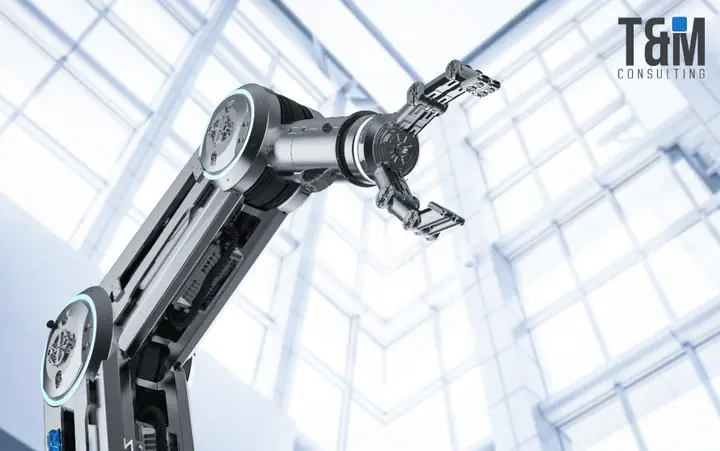
Manufacturing: robotic arms that perform repetitive and precision tasks, improving productivity and reducing occupational hazards.
Industrial cleaning: maintenance robots that operate in high-risk environments or large areas.
Technical inspection: drones and robots with IoT sensors that perform structural, energy, or quality monitoring.
In fact, PwC (2024) estimates that 44% of manufacturing companies in Latin America are already evaluating the incorporation of robots under subscription schemes in the next three years.
Competitive advantages of the RaaS model
Cost reduction: no initial investment or equipment depreciation expenses.
Immediate scalability: robots can be added or removed according to business demand.
Maintenance and support included: the provider is responsible for technical service and updates.
Access to cutting-edge technology: users receive upgraded hardware and software at no additional cost.
Accelerated productivity: implementation times are shorter than those of traditional automation.
On average, companies that adopt RaaS report a 30% improvement in operational efficiency and a return on investment in less than 18 months (IDC Robotics Report, 2023).
AI and IoT: the new brain of automation
The true value of RaaS is multiplied when it is integrated with Artificial Intelligence (AI) and the Internet of Things (IoT).
Today's robots don't just execute commands: they learn from their environment, predict failures, and optimize processes in real time.
For example, IoT sensors allow a robot to detect bottlenecks in a production line, while AI algorithms automatically adjust its routes or movements to maximize efficiency.
Success stories: inclusive automation
Small and medium-sized businesses in sectors such as retail, manufacturing, and logistics are using RaaS to automate processes without compromising their working capital.
In Mexico, several SMEs have adopted modular mobile robot solutions on a monthly subscription basis, reducing operating costs by up to 45% compared to traditional automation models.
Conclusion: the future of automation is accessible
Robotics as a Service is not just a trend, but a competitiveness strategy.
By adopting this model, companies can innovate with agility, scale operations, and free up resources for other strategic areas.
At T&M Consulting, we help organizations integrate smart technologies such as RaaS into their digital ecosystem, driving efficiency, sustainability, and continuous growth.
Contact us at contact@tmconsulting.mx
Find out more at tmconsulting.mx