Vibe Coding: When AI Writes and Humans Guide
As tools such as GitHub Copilot, Amazon CodeWhisperer, and GPT-4o are integrated into workflows, the role of the programmer changes radically. In this article, we explore what exactly vibe coding is, what its practical implications are, and how it can become a competitive advantage for SMEs and agile development teams.
What is vibe coding?
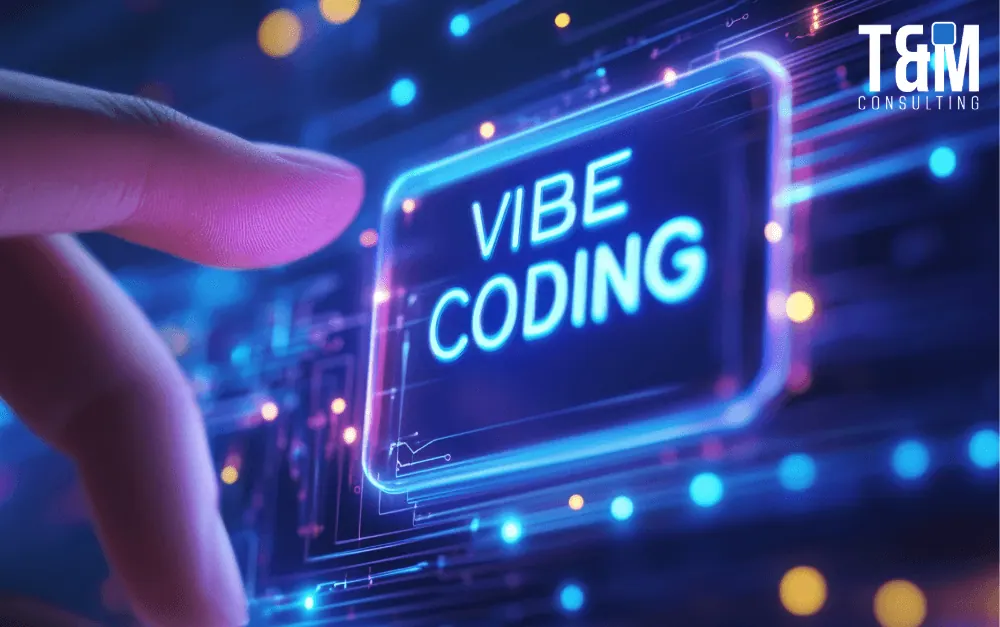
The term “vibe coding” refers to a new way of developing software in which the programmer focuses more on defining the purpose, overall logic, and functional objectives of a solution, while AI automatically generates much of the code needed to implement it.
Unlike traditional coding, where each line must be written and adjusted manually, in vibe coding, interaction with AI is fluid and dynamic. The developer provides instructions—through prompts in natural language or pseudocode—and validates the AI's output, refining the solution until the desired result is achieved.
Advantages of vibe coding for companies and developers
Faster development:
Repetitive tasks, such as creating auxiliary functions, basic documentation, or unit tests, are delegated to AI.
This allows teams to deliver products in less time, reducing time-to-market.
Focus on design and business logic:
Developers spend more time thinking about architecture, usability, and user experience.
AI is responsible for turning ideas into operational code.
Better experience for new programmers:
For those just starting out, vibe coding can serve as a guide to best practices and structure.
It reduces the technical barrier and accelerates learning.
More agile prototyping:
Preliminary versions of an application can be built in hours, not days.
Ideal for rapid validation in innovation environments.
Challenges and ethical considerations
Although promising, vibe coding is not without its challenges:
Dependence on AI:
Overreliance on automatic generation can hide logical or security errors.
It is essential to review and test all generated code.
Privacy and code ownership:
There are debates about whether AI-generated code may contain fragments similar to software with restrictive licenses.
Biases and inaccuracies:
AI can generate code with suboptimal patterns if not guided correctly.
The role of the “prompt engineer” in vibe coding
One of the key emerging skills is the ability to write effective prompts. The “prompt engineer” understands how to communicate with AI to obtain useful and accurate results. This involves:
• Knowing the capabilities and limitations of the model.
• Formulating clear instructions, with context and constraints.
• Evaluating outputs and adjusting prompts iteratively.
This role is becoming essential in modern development teams and can make a difference in the productivity achieved with AI.
How to start implementing vibe coding in your company?
• Adopt AI-friendly tools: Platforms such as Visual Studio Code, Replit or JetBrains already integrate intelligent assistants.
• Train your team: Not only in the technical use of AI, but also in soft skills for communicating with language models.
• Define best practices: Establish rules about when to trust AI, how to version generated code, and how to review it.
• Evaluate its impact: Measure productivity, code quality, and team satisfaction before and after implementation.
Vibe coding is not a passing fad, but a paradigm shift in the way we program. If applied judiciously, it can increase productivity, improve software quality, and free developers to focus on what really matters: solving complex problems, innovative design, and creating value.
Tech SMEs that adopt this trend intelligently will have a real competitive advantage in the age of artificial intelligence.
Want to take your business development to the next level with AI and SAP? Write to us at contact@tmconsulting.mx or visit tmconsulting.mx